
Mastodon

I’m Christian: Senior Consultant by day, FreeBSD person by conviction. Hands-on writeups about jails, BGP, self-hosting and Linux, all from infrastructure I actually run.

#ai Articles


Newest

A Read-Only AI Reviewer for Forgejo Pull Requests

A small Python service that reviews every pull request on my self-hosted Forgejo with an LLM, posts a summary and inline findings, and is not allowed to do anything else. The interesting part was not getting a model to comment on a diff. It was getting it to stop being confidently wrong about code it had never seen, and making sure a misbehaving or manipulated bot could not change a single line.
Earlier articles

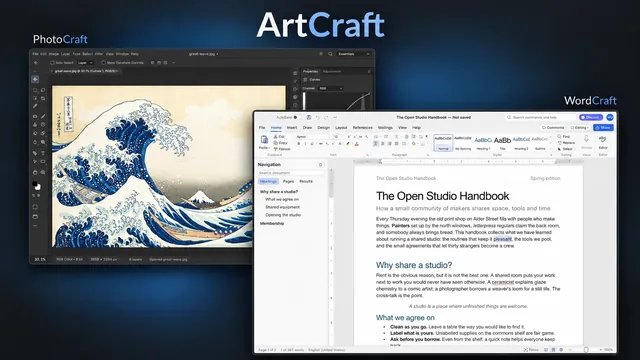
ArtCraft: Desktop Apps Built with AI, Useful Results, and Open Questions

ArtCraft is attempting to rebuild familiar creative and office applications in Rust with AI coding agents. PhotoCraft worked for my thumbnails, the applications started quickly, and native FreeBSD builds exist. Those are interesting observations, but they do not establish equivalence with Photoshop or Office. A look at the project, its agent-friendly architecture, and the questions that remain about correctness, maintenance and its future.

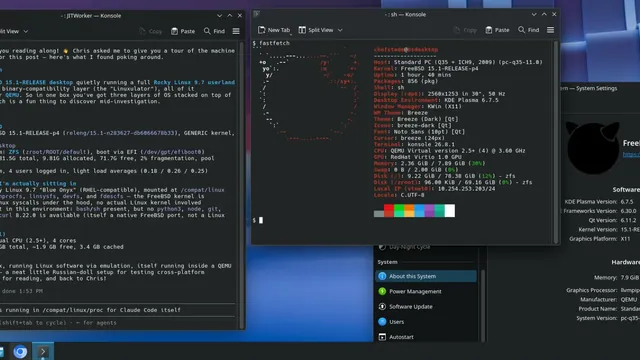
Claude Code on a FreeBSD Desktop: Plasma, xrdp, the Linuxulator and One Very Confusing PATH

A FreeBSD 15.1 Plasma desktop in a Proxmox VM, reachable over xrdp, running Claude Code as a Linux binary through the Linuxulator. Along the way: an Xorg that found no screens, a KRDP package that does not exist, a VirtIO-GPU that gives you a framebuffer but no acceleration, and a “version regression” that turned out to be two Claude installations fighting over my PATH. Then I let the agent firewall the machine it was running on, and it did that more carefully than I usually do. It also got one thing wrong, and of course it was the thing about root.

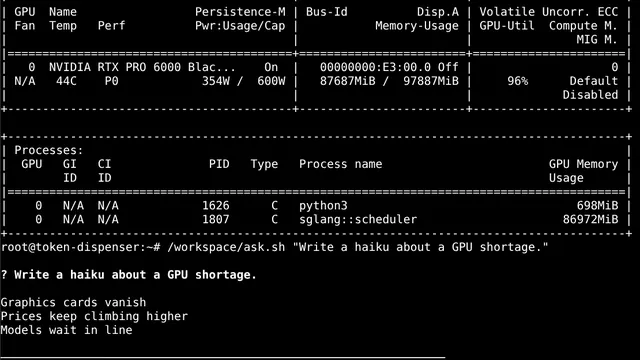
Self-Hosted AI: Qwen 3.8 on a Rented Blackwell at 150 Tokens per Second

An open-weight Qwen 3.8 27B model, an RTX PRO 6000 Blackwell rented by the hour, and one shell command to start it. For most of my everyday coding it is good enough, it answers at roughly 150 tokens per second, and my prompts stay on infrastructure I chose. Some honest caveats about what “self-hosted” means on someone else’s GPU are included, along with the workflow that has worked best for me: a frontier model for architecture, and a fast open-weight model for the token-heavy implementation loop.

The AI Stack I Actually Run in 2026: A Laptop iGPU and Four Rented Frontiers

The most interesting thing about AI in 2026 is not which frontier model wins this month’s benchmark. It is that the frontier became a commodity you rent through near-interchangeable clients, while the part with actual craft in it moved onto the integrated Radeon 780M in my laptop. Here is the tiered stack I actually run, with the local layer in detail because that is the unusual part, and the cloud layer kept brief because the pricing is on the vendors’ own pages and will be wrong by autumn.